
After the melt
The media cycle has moved on from Greenland, but climate, conflict and $$$ haven't!

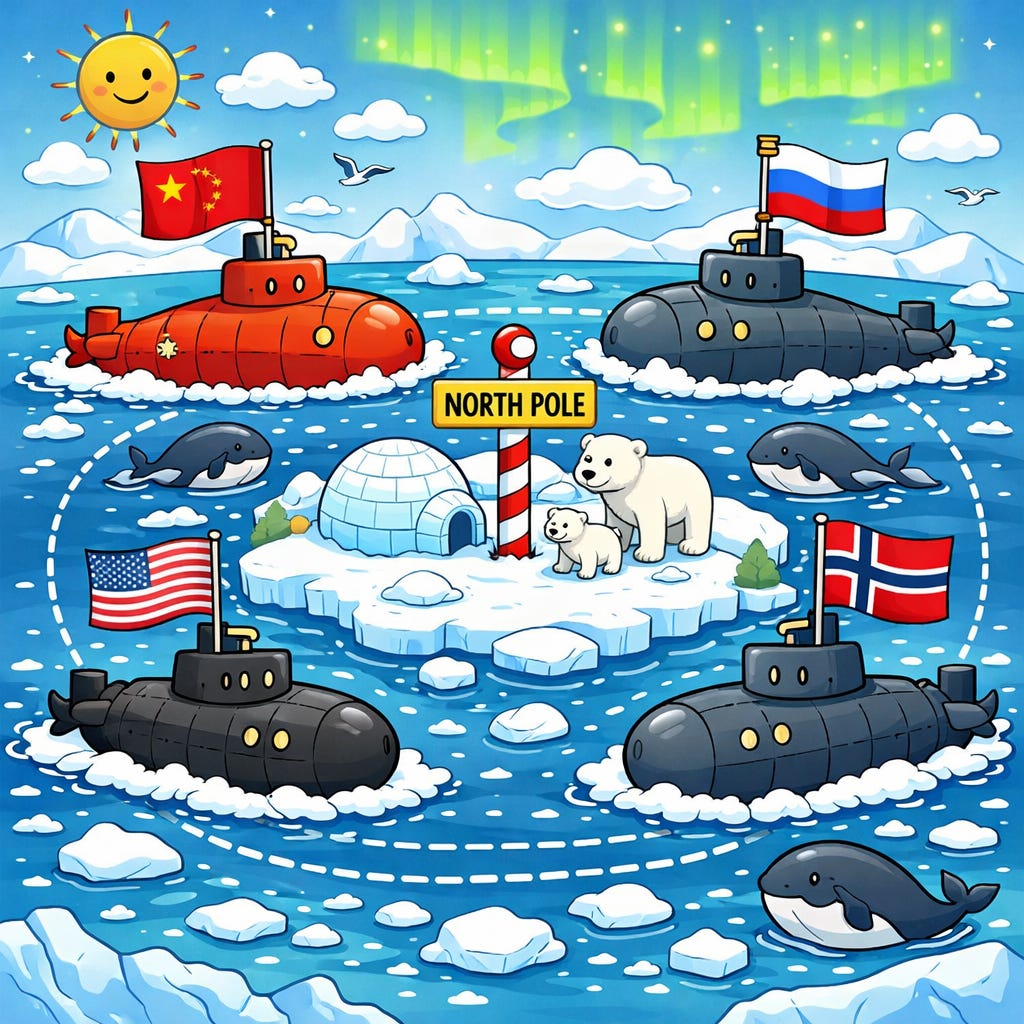
There has been SO so much ink spilled on Greenland already from many angles. Now that the dust has settled between Trump, Denmark and NATO for now, and the Munich Security Conference passed without more Greenland headlines, it’s a good time to think about the less heralded angles to the story and why the world will almost certainly return its gaze to the Arctic in the years ahead.
Where’s the nexus with the climate side of things?
First, the obvious one: a warmer ocean. Sea ice reflectivity is weakened if not disappears entirely for long stretches. This means sunlight is absorbed and not reflected. The melting lowers water salinity, reducing its density near the surface. Because of the reduced ice coverage, strengthening the halocline, or the underwater boundary between fresher surface water and saltier water beneath, critical for the generation and perpetuation of deep ocean currents. There are multiple, complex feedback loops impacting this, but research and modelling suggest some relationship between the gradual increase in fresh water from the Arctic impacting North Atlantic currents (the AMOC). Major changes, or a collapse in the AMOC could have significant, medium and long term impacts to fishing and agricultural productivity on both sides of the North Atlantic and beyond - as one of many global impacts.
Melting polar ice caps also means Greenland’s ice cap also accelerates its disappearance. Also negative contributor to the first bullet.
Changes in salinity will impact a ship’s seaworthiness in the Arctic by impacting its buoyancy (saltier water is more buoyant). Arctic-grade vessels today may not be usable, or need expensive adjustments (e.g. materials, hull designs), to adapt to fresher Arctic seawater. This impacts everything from icebreakers and container ships to submarines and frigates. Aging vessels would particularly struggle with changing conditions especially if they are beyond their original service life (this is especially urgent for the US in the Arctic / Antarctic context).
Permafrost melting rates increase, releasing large amounts of CO2 and methane - predominantly in Russia and Canada. This is hugely damaging to onshore infrastructure like gas pipelines, roads, not to mention habitats for entire ecosystems. A somewhat cynical medium-term outcome is the gradual increase of arable land for Russia and Canada, though whether the economic, social, environmental and political benefits outweigh the cost from physical climate risks is questionable at best.
Broader changes to the High North environment, including increased runoff of ice caps / snowmelt and wildfires damaging ecosystems, accelerating ground heat absorption and accelerating positive heating feedback loops.
OK so what for Arctic security?
Two of the thought leaders in the climate security space, John Conger and Sherri Goodman, have commented on this topic in recent weeks. I encourage you to check them out, as well as Duncan Depledge from Loughborough University in the UK! Below are my thoughts:
Military vessels operating in the Arctic may need refurbishments to operate in waters where changes in salinity create operational challenges
More open sea lanes means greater capability for adversarial surface vessels to operate in wider ranges - in practice, the US, Russia and potentially China would seek to push freedom of navigation transits to assert de facto control of critical waters. This creates greater scope for near-misses and confrontations.
More open sea lanes invites greater commercial shipping activity, particularly via the Bering Strait and the GIUK (Greenland-Iceland-UK) gap on either side of Svalbard. Shipping lanes and supporting port and communications infrastructure need to be in place and secured. These also invite greater military competition. Russia, already in control of half of the Arctic coastline, would seek to dominate control of most future shipping traffic.
And to that effect, the changing environment opens up more mining and oil / gas exploration activity. Well, that’s going need to be secured too (see: Guyana).
Norway’s ability to control Svalbard becomes more critical militarily for the US and NATO. Svalbard, via historical treaties, has a prominent Russian presence. Norway, pushing to develop Kirkenes port on its mainland, is under pressure to curtail Russian influence and manage the Chinese presence e.g. limit Svalbard access and influence on Kirkenes while welcoming commercial traffic to/from China.
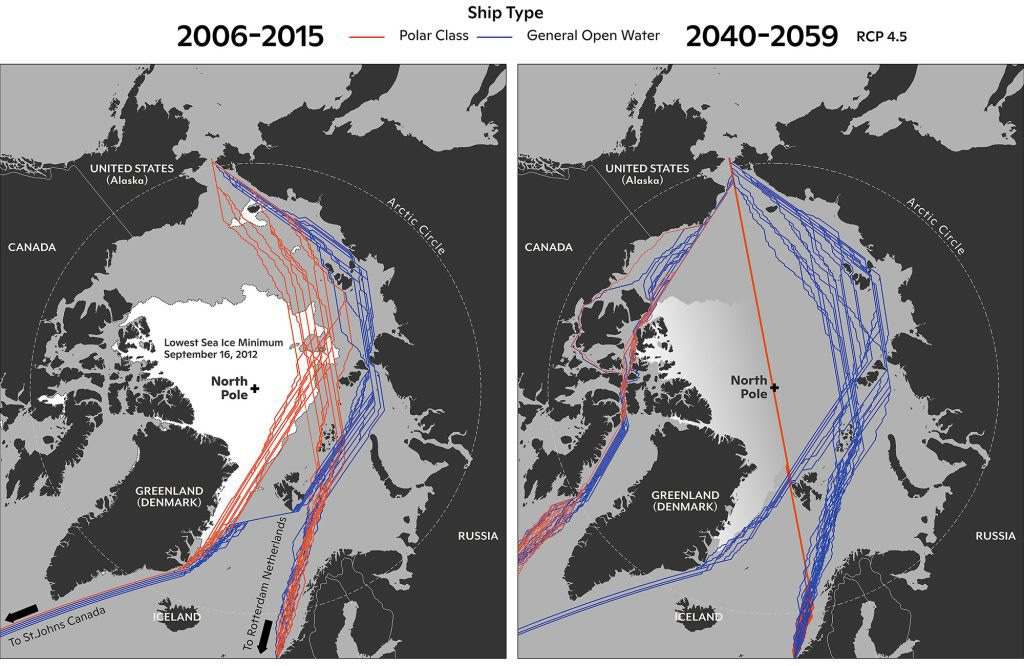
By mid-century, two distinct shipping lanes are likely to emerge. Source: NOAA Melting permafrost sinks ground levels. Changing onshore environments may threaten the stability of onshore infrastructure and bases e.g. water systems, fuel storage, roads, concrete and metal structures etc. This could negatively impact force preparedness and uptime for early warning systems critical for missile detection. Much of US and Canadian Arctic military infrastructure has been underinvested; massive upgrades are needed to make them climate resilient and mission-ready in a more competitive region into mid-century.
People living in the High North, such as Canada’s Inuit population, have faced decades of underinvestment and isolation - they are among the most vulnerable to the physical risks from new climate realities, threatening everything from traditional livelihood patterns to food and water security.
For policymakers - revitalising the Arctic Council as the one-stop multilateral high level policymaker body, with greater remits to ensure environmental, economic and scientific research concerns have governance with teeth. That’s the first prize in my opinion to manage both the climate and geopolitical transitions the region is inevitably facing. Short of a radical US-Russian rapprochement where the Washington and Moscow properly split the Arctic into eastern and western hemispheres, second prize may be the US and NATO agreeing on how to securitise future commercial activity in the region. I see China as a potential “swing vote” largely dependent on a) if the US and China and find a more sustainable rapprochement and b) the durability of China-Russia ties. It’s probably unrealistic for China to be “denied” access to be Arctic, least of all from a commercial perspective. So there may be some space for policy engagement: for the US / NATO it would be seen as trying to pull China to be more “equidistant” policy-wise vis-a-vis Moscow on Arctic concerns.
Second for policymakers: Canada is pushing on a C$1bn Arctic civilian-defence infrastructure fund. That’s commendable, but probably not nearly enough given military requirements and the added cost of logistics and delivery in harsh physical environments. Governments need to make make it easier for private capital - beyond defence-tech startups and their VC backers - to get their foot in the door to deploy capital while spreading risk out e.g. off balance sheets, export credit underwriting etc. This also needs to happen with projects focused on, or could benefit, Arctic security.
Where security, resilience and climate converge: “sustainable resilience”
I’ve done a bit of a deeper dive here but I’ll share some highlights:
If you’re a player already in the defence space then doing more here is a no-brainer, plugging into RFIs and RFPs or existing contracts that support maintenance and growth in Arctic missions.
Minerals: This is more of a medium-longer term prospect should the US and Denmark ultimately agree here - and there’s good political reasons to believe that down the line, US demand and EU energy transition and supply chain resilience imperatives will win out over longstanding mining prohibitions. Amanda van Dyke has written about the critical minerals issue specific to Greenland in much greater detail if you want to read more.
Sensors - this is probably the most obvious one. Much more should be known from a climate science perspective about the changing Arctic. This requires sensors, many more of them. Deploying them requires cooperation across government, corporates, manufacturers and shipbuilders and academic research. A good example is Canada’s Dominion Dynamics, which has received VC backing to develop and deploy persistent drone-based sensor networks primed for Arctic conditions. Alaskan startup beadedcloud is another sensor maker doing interesting things geared for the High North. These can be used for both environmental and military C2ISR needs. Data collected would have tremendous scientific, policy and commercial value. On the latter, a range of users from data brokers, climate analytics firms, insurers, shipping, telecommunications, energy transport, to name a few, would find this useful.
Undersea cables - this has been bandied about for years with multiple failed attempts for commercial or political reasons. Melting ice caps probably opens the door in the coming 5 years, with political tailwinds at least in the West, for existing projects like Far North Fiber and Polar Connect to be completed, with greater appetite for more from national security and digital players like Meta and Google seeking minimal latency between key data centre clusters. Technologies piggybacking on subsea cables like those deployed by Smart Cables could have interesting dual-use climate defence applications.
Icebreakers - Even with melting ice caps, the Arctic isn’t expected to be ice free year round in entirety for some decades. Quickly building or refreshing fleets is getting harder: Finland has built 60% of the global icebreaker fleet and designed much of the remainder. Russia has the largest icebreaker fleet with over 100, with Canada second with around 50. The US has under 20 - only 3 polar icebreakers belong to the military (Coast Guard) with two more planned and being built in…Finland! China having its own docks. For the US and NATO allies, Finland and Canada are the only options. And shipbuilding leadtimes are lengthening given the record backlog of container vessel orders to shipyards, which implies new (non-Chinese built) vessels which are adaptable to a changing Arctic would be at best drip-fed well into the 2030s.
Arctic ports - perhaps the chunkiest bit for fund managers and their LPs. Developing and operating ports is a model well known in the infrastructure world. Looking at existing global routes, Arctic ports like Nome, Kirkenes, East Iceland and Murmansk stand to benefit, while near-Arctic ports like Vladivostok, Halifax, Yokohama, Anchorage, Oslo and Seattle may see greater traffic. There also may be implications for volume and flow for major global ports like Ningbo / Yangshan, Rotterdam and Singapore. The challenge is, it’s hard to estimate if there are large enough projected additional demand to make development attractive enough for big investors. Cynically, the more the ice melts, the more viable Arctic sea lanes are…